This section gathers the earliest stories, descriptions, and theories about Old Finn — drawn directly from the lake’s oldest whispers and historical clues.


The First Whispers

Every summer, as the sun warms the waters of Runyan Lake and families gather for fishing contests and fireworks, whispers begin to ripple across the shoreline. Whispers of Old Finn, the legendary creature that no one has ever caught.


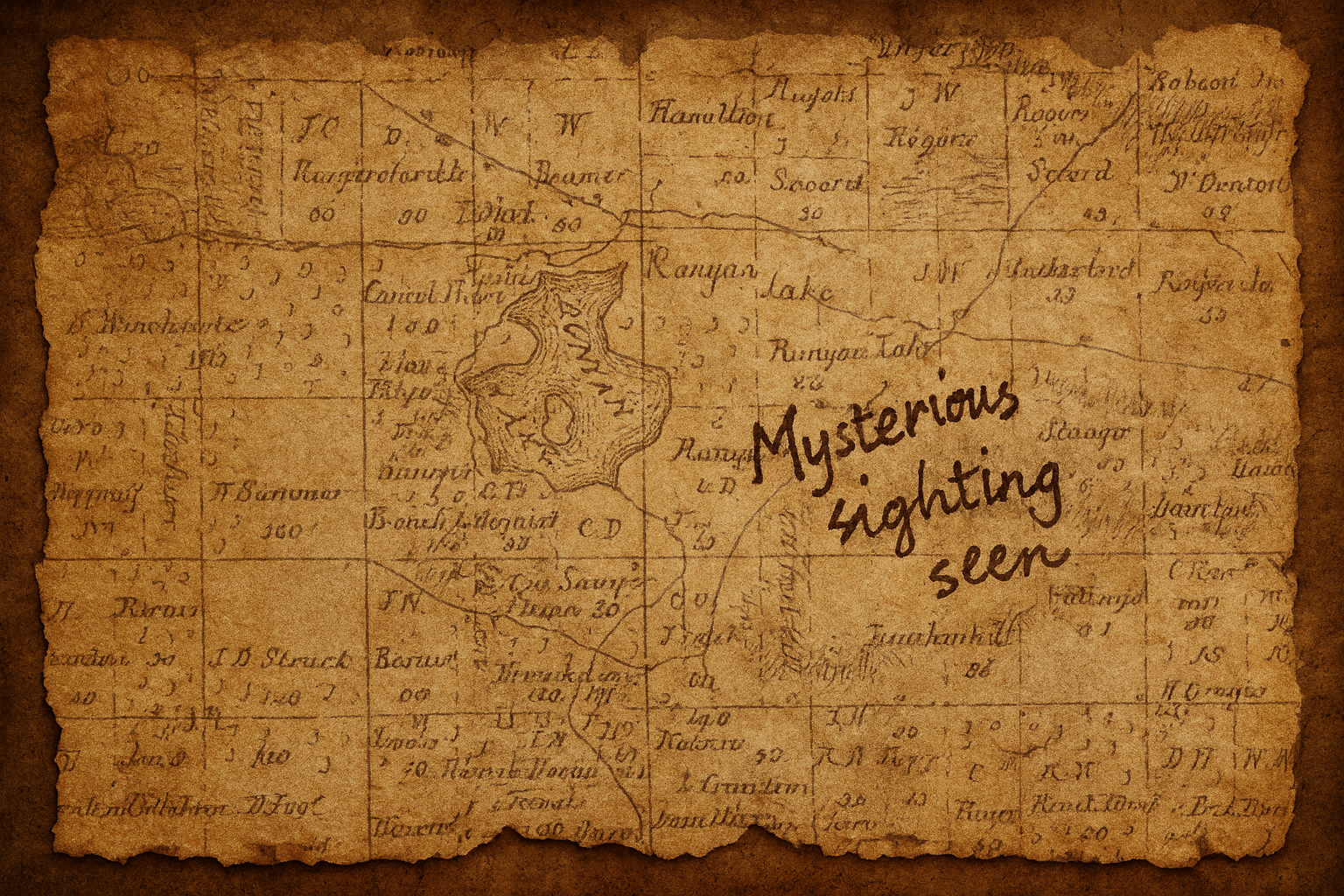
Aged map of Runyan Lake with
An aged map of Runyan Lake, with the haunting inked note “Mysterious sighting seen” near the island — a whispered trace of Old Finn’s earliest sightings.

Some say Old Finn is as long as a canoe, while others say he is longer than a telephone pole. Almost all the old legends give Old Finn scales that shimmer like fireworks and eyes that glow like huge red lanterns in the dark. His body is said to move with the grace of a lake herring, the power of a northern pike, and the ancient resilience of a bowfin. His snout, long and elegant like a gar’s, hints at a lineage older than the lake itself. He’s believed to dwell in the deep waters throughout Runyan Lake, but mostly near the island — the same island where the fireworks are launched every 4th of July.


Watcher’s Rock & the Island’s Mystery

But Old Finn isn’t just any fish — or even necessarily a fish at all. According to the oldest maps from 1859, Runyan Lake has always had a mysterious island. Long before the cement factories came and went, before the fireworks and boat parades, the island was known as “The Watcher’s Rock” — a place where strange ripples would appear even on windless days. Some believe it was here that the lake’s guardian first took shape, formed from the essence of its most iconic species.


Origins of the Guardian

Some say Old Finn was born from the marl deposits that once made the lake famous. Others believe he was created by a mix of clay, magic, and memory — woven together from the lake herring that once shimmered in the depths, the gar that patrolled the shallows, the pike that ruled the reeds, and the bowfin that endured through every season. Whatever the truth, one thing is certain: every time someone tries to catch him, something strange happens.


The Healing of the Lake

One of the oldest legends tells of the time when the cement factories left the lake behind — after years of extracting marl and reshaping the shoreline. The waters were quiet but wounded. Fish populations dwindled, and the lake seemed to lose its rhythm. That’s when, some say, Old Finn first appeared — not as a threat, but as a healer.


They say he stirred the sediment, summoned the minnows, and guided the currents to cleanse the lake’s heart. Families who lived through that time recall sudden blooms of dragonflies, the return of native plants, and fish spawning in places long thought barren. Whether myth or miracle, the lake began to recover. And ever since, Old Finn has been seen — if only in stories — as the spirit who watches over its health.

This section gathers all descriptions of how Old Finn appears, moves, changes, and responds to the lake and its people — exactly as recorded in the original Runyan Lake legends.


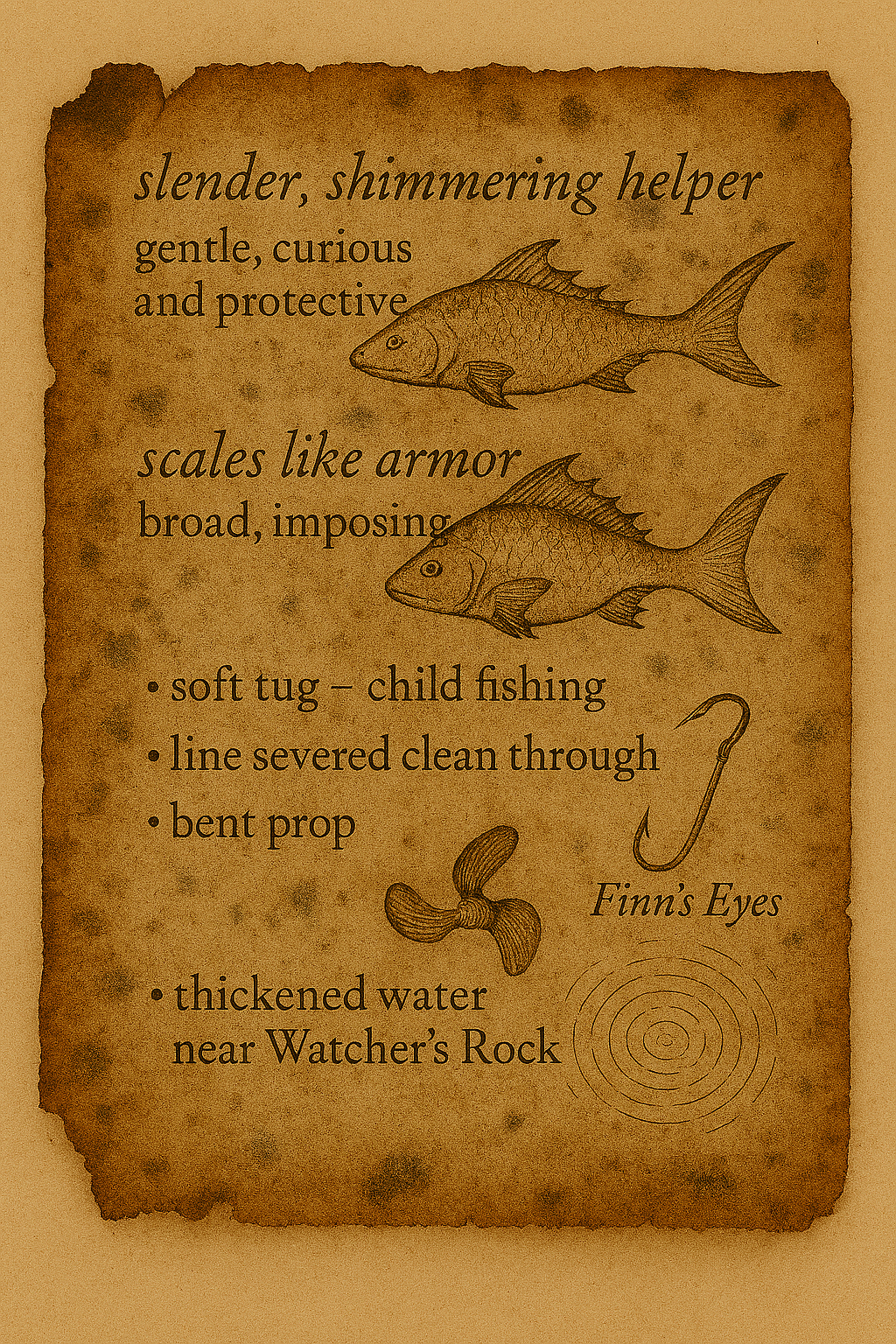
A torn, aged ledger page with handwritten notes and sketches describing Old Finn’s shifting forms and mysterious behaviors
A torn page believed to have been removed from the Blanchard ledger — preserving early notes on Old Finn’s slender helper form, armored guardian form, and the strange signs left behind on hooks, props, and water.

Shifting Forms

Old Finn is said to appear in multiple forms, each shaped by the state of the lake and the intentions of those who enter its waters. To children in need, or to those who treat the lake with care and reverence, he may appear as a slender, shimmering helper — gentle, curious, and protective. These stories speak of soft ripples, glowing eyes in the mist, and small gifts left behind during dark moonless nights: smooth stones, twisted reeds, or even items long lost placed neatly at the end of a dock.


But when the lake is disrespected — polluted, overfished, or disturbed by reckless boating — Old Finn is said to change. He becomes broader, more imposing, with scales like armor and a tail that churns the water with warning. Boats return with bent props, vanished anchors, or hulls marked by deep, unexplained scratches. Whether coincidence or consequence, the stories always end the same: Old Finn protects what belongs to the lake.


Movement & Presence

Old Finn is believed to dwell in the deep waters throughout Runyan Lake, but mostly near the island — the same island where the fireworks are launched every 4th of July. His body is said to move with the grace of a lake herring, the power of a northern pike, and the ancient resilience of a bowfin. His snout, long and elegant like a gar’s, hints at a lineage older than the lake itself.


Some stories describe him stirring sediment, summoning minnows, and guiding currents — movements that seem purposeful, almost ritualistic. Others describe sudden resistance beneath wakeboarders, firm jolts from below, or thickened water near The Watcher’s Rock. These moments are interpreted as reminders, warnings, or quiet acts of guidance.


Behavior Toward the Lake

Old Finn is often portrayed as a guardian whose behavior reflects the lake’s wellbeing. During times when the lake was wounded — such as after the cement factories left — he was said to have stirred the waters, cleansed the currents, and helped restore balance. Families recall the return of dragonflies, native plants, and spawning fish in places long thought barren.


In winter, his presence is felt beneath the ice. Small pockets of open water remain even in the coldest weeks, known as “Finn’s Eyes.” Ripples appear without wind, chills pass through warm coats, and strange sounds echo beneath the ice. Some say these are natural springs; others believe they are signs of Old Finn keeping vigil.


Behavior Toward People

Old Finn’s interactions with people vary widely. Those who treat the lake with respect often experience gentle nudges, calm waters, or unexpected help — such as boats drifting safely back to shore or loosened dock poles easing fall removal. Children casting early lines sometimes feel soft tugs or swirling water, interpreted as reminders or greetings.


Those who disrespect the lake encounter different behavior: snapped lines, tangled gear, frozen holes, bent props, or unexplained scratches. During the fishing contest, cheaters or those who push the lake’s limits face severed lines, straightened hooks, or a season of bad luck. These stories reinforce the belief that Old Finn watches closely and responds with precision.


This section gathers seasonal sightings, behaviors, and whispers about Old Finn — moments when the lake’s guardian may have been seen, felt, or simply imagined. Not all are sightings. Some seem like cautions, quiet reminders to tread lightly. But all are part of the lake’s story.


🌱 Spring — When the Lake Wakes Gently

As the ice melts and the shoreline softens, Runyan Lake begins to stir. The weeds, still pale from winter, begin to sway just below the surface, dancing in slow spirals as the water warms. Fish settle onto their beds — nesting in quiet circles, preparing the lake for another season.


Old Finn is said to rise slowly from his winter lair beneath the island, not with a splash, but with a ripple. He watches the lake’s rebirth: the first green blades of grass, the wildflowers blooming along the banks, and the slow and steady return of boats to the water.


But spring also reveals subtle rearrangements — shorelines that were altered the previous summer or fall now seem slightly different. A row of stones shifted. A dock post leaning just enough to catch the morning light. Not damaged. Just… changed. As if the lake, or its ancient guardian, had spent the winter reconsidering.


Children casting early lines sometimes find their bobbers tugged — not by fish, but by something deeper. A soft pull. A swirl. A reminder.


Spring is when Old Finn watches quietly, measuring the lake’s readiness, and the intentions of those who return.


🌞 Summer — When the Lake Breathes Loudest

When the lake is alive with boats, laughter, and fireworks, Old Finn is said to be most active. Sightings peak during the fishing contest, the 4th of July show, and long twilight paddle board rides. Children speak of soft ripples that seem to lightly propel their boards, as if the lake itself is guiding them forward. Some say it’s Old Finn offering a gentle push to those who treat the water with care.


Wake boarders who stray too close to the shallows near The Watcher’s Rock tell a different story. A few report sudden resistance, as if the water thickens beneath them. Then comes the bump — a firm jolt from below, enough to throw balance or twist a tow rope. Whether it’s the lake’s warning or Finn’s quiet reminder, summer is when the lake breathes loudest — and when Finn listens most closely.


🍁 Autumn — When the Lake Begins to Listen

As the trees blush red and gold and the lake cools beneath a thinning sun, Runyan Lake enters a season of listening. The bustle fades, and Old Finn is said to slip deeper into the lake’s memory — watching not with curiosity, but with quiet contemplation.


Some say this is when he returns to his lair beneath the island, where the lake’s memory lives. There, he drifts through the echoes of summer — the laughter, the contests, the fireworks — and reflects on what the season brought. Not to judge, but to remember.


Boats that come untied in the fall breezes sometimes find their way back to shore, nudged gently by unseen currents. At the boat ramp, trailers that groan and resist suddenly ease forward, as if the lake itself is helping the vessels home. Locals speak of loosened poles that make taking out their docks easier, while others speak of permanent docks that creak once — then fall silent, like a farewell.


And some say if you watch the lake closely as night falls, just before the frost, a single ripple breaks the surface near the island. Old Finn, they say, is listening.


❄️ Winter — When the Lake Sleeps Soundly

Winter settles over Runyan Lake with a hush. The days grow short, the air sharp, and the lake begins to freeze — but never fully. Scattered across the surface, small pockets of open water remain, even in the coldest weeks. Those residents who stay call these places Finn’s Eyes — dark, unfrozen circles that seem to watch the lake in silence.


Some say the open water is caused by natural springs. Others believe it’s Old Finn, keeping vigil beneath the ice. He’s said to rise only when the moon is high and the ice is thick, drifting slowly beneath the surface, watching the snowmobilers, skaters, and cross-country skiers who trace paths across the lake.


Most steer clear of Finn’s Eyes, not out of fear, but instinct. A ripple there can appear without wind. A sudden chill may pass through even the warmest coat. And sometimes, in the first light of morning, the snow around those spots begins to shift and shimmer, as if something beneath the ice is tapping out a rhythm only the lake understands.


Ice fishermen speak in hushed tones about strange sounds beneath the ice — a low groan, a sudden swirl, or a ripple that shouldn’t be there. Those who fish with care, taking only what they need and releasing what they shouldn’t have caught, report good luck and clear waters. But those who overreach sometimes find their holes freeze faster than expected, or their gear tangled in ice that wasn’t there moments before.


And then, late into the night, when the lake is still and the stars hang low, a sharp cracking sound echoes across the ice. Some say it’s spring arriving — nature stretching beneath the surface. Others say it’s Old Finn, breaking the ice himself, helping the thaw begin, nudging the lake toward its first breath of Spring.


This section gathers the lake-wide rituals, warnings, and traditions that have grown around Old Finn — practices meant to show respect, avoid misfortune, or honor the lake’s ancient guardian.


🎣 The Fishing Contest Rituals & Warnings

During the annual Runyan Lake Fishing Contest, anglers line their docks hoping for bass, perch, or a surprise pike for the contest weigh-in. But every year someone swears they hooked something enormous — so powerful the line snapped like dry spaghetti and left them reeling in only broken line. One summer a young angler claimed Old Finn leapt during the weigh-in, “he had fireworks in his tail,” the child shouted; that same night a giant splash interrupted the opening shell of the fireworks show and the island seemed to tremble.


Folks tell this as a warning and a wonder at once: don’t treat the contest like a challenge to the lake. Cast with respect, never gaff for sport, and if a catch fights in a way that feels otherworldly, let it go. Those who return to boast about a near-catch sometimes bring back more than a story — tangled lines, broken rods, or boats with unexplained damage — and a hush that follows them for weeks.


Cheaters and those who push the lake’s limits find the curse simple and precise: lines severed clean through with no abrasion, lure hooks mysteriously straightened though no twitch of a rod was felt, and an entire season of luck that dries up as if the water itself has turned against them. Some call it coincidence or bad luck; others know better, having watched twin lantern-like red eyes — huge garnet orbs — dance along the waterline where their bobbers should have been.


A small ritual grew around the contest: before the weigh-in, many anglers observe a moment of silence for whatever swims beneath, then toss a small offering into the deep — a natural, unglazed clay token made from Runyan Lake’s shoreline, a sprig of cedar, or a handful of native wildflower seeds. The story goes that Old Finn accepts these tokens and, in his own mysterious way, returns them to the lake as a blessing, feeding the insects and minnows that in turn nourish the fish for the length of the tournament.


For tournament winners who leave a single dim red lantern burning on their dock, Old Finn is said to visit late at night, circle once in the dark, and rest his great head against the pilings in a quiet salute until the next tournament.


🎄 Winter Tree Offering — A Gift to the Lake

When the holidays pass and the lights dim along the shoreline, a quiet tradition begins to unfold around Runyan Lake — one not written in any official guide, but passed from neighbor to neighbor, from old-timers to newcomers, and from grandparents to wide‑eyed children bundled in scarves.


It begins with the Christmas trees. By late December, the lakeshore families gather their old trees — stripped of tinsel, hooks, glitter, and anything that doesn’t belong in the water. The branches are shaken clean, the trunks trimmed, and the needles brushed free of anything artificial. Some families even rinse the trees with lake water, a symbolic gesture to “return them as they came.”


The purpose is practical and ecological: to create new habitat for young fish. Old trees, once anchored beneath the ice, become shelter for minnows and forage species, spawning grounds for spring fish, and a nursery for the lake’s smallest lives. Algae grows on the branches, insects gather, and the food chain begins again. It’s a sustainable recycling ritual — one that keeps the lake healthy and thriving.


But the practical reason is only half the story. The other half belongs to Old Finn. On the coldest mornings, when the ice is thick and the shoreline crunches under boots, families drag their cleaned trees to the drop points. The lake is quiet then — the kind of quiet that makes every breath sound like a whisper. And as they approach the ice, some swear they see it: two faint red glows beneath the surface. Not bright. Not frightening. Just watching.


Old Finn’s eyes appear near the holes cut for the trees, drifting slowly beneath the ice like lanterns in deep water. Children point. Adults pretend not to see. But everyone feels it — the sense that the lake’s guardian is present, observing, approving.


Some say the eyes brighten when a tree is especially well-prepared — free of tinsel, hooks, and anything that could harm the fish. Others say the eyes dim or drift away when a tree is left with plastic or metal still tangled in its branches. Whether truth or tale, the message is the same: respect the lake, and the lake will thrive.


Once the tree is lowered into the water — weighted with natural stone or biodegradable anchors — the eyes often circle once, then fade into the deep. A swirl of bubbles rises. The ice creaks. And the families return home with cold hands and warm hearts, knowing they’ve done something good for the lake.


By spring, the trees are alive with minnows. By summer, young fish dart through the branches. By autumn, the lake is richer for it. And by winter, the cycle begins again.


Some call it habitat restoration. Some call it stewardship. But around Runyan Lake, most simply call it: the Winter Tree Offering — a gift to the lake, a promise to the future, and a quiet moment shared with the guardian who watches from below.


🎆 The Fireworks Pact

Every 4th of July, as the sun dips behind the trees and boats gather near the island, Runyan Lake holds its breath. The fireworks show is more than celebration — it’s a ritual. And Old Finn, the lake’s ancient guardian, is always watching.


Locals say the island — once called The Watcher’s Rock — was chosen not just for its central location, but because it sits above a secret deep and spring-fed channel. Rumor has it that’s where Old Finn sleeps — in a submerged chamber where the lake’s memory lives and grows with each passing season.


As the first shell bursts overhead, the water below begins to shimmer. Some say Finn dances with the aquatic echoes of each explosion, swirling beneath the surface in perfect rhythm. Others believe he’s drawn to the colors — especially the reds and blues, which, if one watches close enough, reflect against the scales across his back.


There’s a reason the island is closed off during the show. Not just for safety, but to honor the pact: disturb not the guardian when the sky thunders. One year, a boat drifted too close. The fireworks paused. A ripple shook the shoreline. And the boat returned with its anchor twisted like a corkscrew.


Some families claim they’ve seen Finn leap during the finale, his tail catching the light to match the fireworks streaking toward the sky. Others say he leaves behind clues — like a single shimmering scale on a seawall edge, a twisted anchor line, or a splash with no source.


And then there’s the map. Hidden in the archives of Runyan Lake Inc., it marks some of Finn’s lairs with a tiny fish symbol in locations throughout Runyan Lake. This final clue mostly appears during the fireworks, when the reflections on the water reveal the path.


So, when the sky lights up and the lake glows, remember: it’s not just a show. It’s a summoning. And Old Finn is listening.


This tab gathers the deeper history of Old Finn — the documents, artifacts, and long-held secrets that reveal how far back the legend truly goes. These are not family stories or dockside tales; they are the lake’s oldest records, preserved across generations.


The Blanchard Ledger — The First Written Account

Long before Runyan Lake had fireworks shows, fishing tournaments, or even a proper association, there was the Blanchard family — early settlers whose journals recorded storms, harvests, and the strange happenings around the water.


Among their papers was a small, leather‑bound ledger. Water‑stained. Edges curled. Ink blurred in places as if the lake itself had tried to reclaim it. Inside were the earliest known written references to Old Finn.


The entries were sparse but unsettling:

  • “Saw the red eyes again near the deep channel.”
  • “Something brushed the hull. Not fish. Too large.”
  • “The lake remembers.”


One page, torn at the corner, described a “great shadow” circling beneath the ice during a winter storm — a detail that echoes modern sightings almost too closely to ignore.


The ledger vanished for decades, only to reappear in the 1970s during a cleanup of the old Blanchard boathouse. No one knows how it survived. Some say it was hidden deliberately. Others whisper that it was returned.


Whatever the truth, the ledger became the foundation of the lake’s deeper lore — the first written proof that Old Finn’s story stretches back far beyond living memory.


The Map of Lairs — Cartography of the Deep

Tucked inside the ledger was a folded sheet of parchment, brittle at the edges and marked with tiny hand‑drawn fish symbols scattered across the lake. Each symbol corresponded to a place where the Blanchards believed Old Finn surfaced, slept, or circled in the depths.


Some marks were near the island. Some near the drop‑offs. One sat directly over the spring‑fed channel beneath Watcher’s Rock.


The map was eventually transferred to the archives of Runyan Lake Inc., where it remains today — preserved in a protective sleeve, brought out only during trustee transitions or special historical reviews.


Most of the time, it’s just a curiosity. But once a year, during the fireworks show, the reflections on the water align in such a way that the path between the symbols becomes visible — a shimmering trail across the lake’s surface.


Some say this is coincidence. Others believe it’s Finn himself, rising just enough to reveal the old routes. Either way, the map is more than a relic. It’s a reminder that the lake has layers — and that some of its truths can only be seen in the right light.


The Trustees’ Archive — Keepers of the Quiet History

Over the decades, Runyan Lake’s trustees have quietly collected stories, artifacts, and oddities connected to Old Finn. Not out of superstition, but out of stewardship — a sense that the lake’s history deserves to be preserved, even the parts that defy explanation.


The collection is stored in a restricted archive, a climate‑controlled vault used only for official association records and historical materials. Its exact layout is known to only a handful of long‑serving trustees, and access is granted sparingly — typically during leadership transitions or when a piece of lake history needs to be verified.


Inside the archive are:

  • fragments of the Blanchard ledger
  • the map of lairs
  • early photographs with unexplained ripples
  • letters from residents describing sightings
  • a 1950s surveyor’s note about “unusual depth variance” near the island
  • a rusted anchor twisted in a way no machinery could explain


Individually, these artifacts are curiosities. Together, they form a quiet, unsettling mosaic — a record of something ancient moving beneath the surface, generation after generation.


The archive isn’t displayed. It isn’t toured. It simply endures, sealed away, holding the lake’s deeper truths until the next caretaker inherits the key.


The Lake Remembers — Finn’s Long Memory

Every generation believes it is the first to encounter Old Finn. Every generation is wrong.


The ledger, the map, the archive — they all point to a truth older than any single family: Old Finn remembers.


He remembers the storms that reshaped the shoreline. He remembers the first docks, the first lanterns, the first boats. He remembers the offerings, the rituals, the warnings. He remembers the caretakers who treated the lake with respect — and those who didn’t.


Some say the lake itself holds memory like sediment, layering stories over time until they become part of the water. Others believe Finn is the memory — the living archive of Runyan Lake.


Either way, the secrets and legacies of the lake are not just history. They are a living thread, woven through generations, waiting for those who listen.


🧓 Old Finn Tales and Sightings — Family Legends Passed Down

When the Blanchard ledger and its stitched map vanished with the last Blanchard, the Runyan Lake community lost both a record and a ritual that had guided local storytelling for generations. Runyan Lake's Board of Trustees stepped in to hold what remained: fragments of memory, donated sketches, eyewitness notes, and any artifacts families were willing to contribute. The Board’s archive becomes the town’s shared ledger so no single family’s story can disappear again.

The Board’s custodianship is practical and symbolic. Practically, the Trustees provide a secure, organized place for oral histories, photographs, and the maps children create during the contest; they catalog submissions, protect originals from damage, and make approved copies available for family displays. Symbolically, their role turns private folklore into communal heritage—legends are treated as public responsibility rather than a private curiosity.

Keeping the legends under the Board also protects the lake and its stories from exploitation. The Trustees set rules about what can be shared publicly, how photos and excerpts may be used in promotion, and what stays in the archive as a sacred family fragment. This stewardship model lets families keep ownership of their memories while giving the whole Runyan Lake community a measured, respectful way to retell them.

Finally, the Board acts as the thread between past and future. By preserving what remains of the Blanchard record and collecting new maps and dusk photos each year, the Trustees ensure the Secret Map is remade as a living, communal project—one that teaches children to care for the lake and keeps Old Finn’s stories afloat for the next generation.


🚤 The Meisel Family – Old Finn and the Meisel Morning Ripples

They say Old Finn, the ancient spirit of Runyan Lake, sleeps beneath the surface until the first light touches the water. But there’s one thing that stirs him earlier than dawn — the hum of the Meisel boat.

Each morning, like clockwork, the Meisel family glides across the lake’s ski course, carving arcs of precision and joy before most have brewed their coffee. It’s not just skiing — it’s a ritual, a rhythm, a reverence.

Old Finn, curious and cantankerous, once rose to investigate the source of these ripples. Legend has it he watched from the depths, mesmerized by the Meisels’ grace and grit. Some say he tried to mimic their form, others claim he simply nodded in approval before sinking back into the stillness.

To this day, the lake remains glassy for their first run — as if Old Finn himself smooths the water in tribute. And if you listen closely at sunrise, you might hear a low chuckle beneath the waves… or the whisper of a tail slicing through the mist.

Some say it’s respect. Others say it’s protocol. After all, when a family’s morning routine is that presidential, even lake spirits know to stay out of the wake.

🚤 The Maynard Family – The Launch and the Lurker

For years, the Maynard family has been a trusted name around Runyan Lake, known for helping fellow residents launch their boats in the spring and haul them out in the fall. Whether it’s guiding a pontoon down the ramp or securing a fishing boat for winter, the Maynards have always been there—steady, reliable, and lake-wise.

But even the most seasoned helpers have stories they don’t always share.

One late spring morning, while assisting with a particularly stubborn trailer near the boat ramp, a member of the Maynard family noticed the water behind them begin to swirl. The boat hadn’t touched the lake yet, but something was already moving beneath it. “It was like the lake was waking up,” they said. “And it wasn’t happy.”

The boat launched fine, but the engine wouldn’t start. Then the dock rope snapped. The boat drifted slowly into the cove, as if pulled by an invisible current. It took three people to bring it back—and when they did, the hull had a long, deep scratch. No rocks nearby. No explanation.

In the fall, strange things happened again. A boat being pulled out of the water suddenly felt heavier than it should. The winch groaned, the tires sank, and the lake seemed to resist the removal. “It’s like something didn’t want it to leave,” one Maynard whispered.

Now, the family keeps a quiet tradition. Before each launch or haul-out, they tap the boat three times and say:

“We’re just passing through. Let us go in peace.”

Some say it’s superstition. Others say it’s respect. But the Maynards know better. They’ve seen the ripples. They’ve felt the resistance. And they know that Old Finn doesn’t just guard the island—he watches the ramp, too.

🐠 The Verbeke Dock Mystery – The Windsock Warning

Generations of the Verbeke family have hosted the weigh-ins at the dock on the southeast shore of Runyan Lake. It’s a cheerful place during contest hours, with kids laughing, fish flopping, and the iconic fish-shaped windsock fluttering in the breeze to signal that weigh-ins are open.

But locals know: you don’t pull up to the dock when the windsock isn’t flying.

One summer, a young Verbeke reeled in a fish so large it bent the scale—but before it could be weighed, the fish flopped back into the lake with a splash so loud it echoed across the island. The family still keeps the bent scale as a reminder that Old Finn is real—and clever.

But stranger things have happened.

One evening, a newcomer to the lake pulled up to the dock after hours, ignoring the missing windsock. As they stepped onto the boards, the water beneath them began to bubble. Their boat rope untied itself and drifted away. The dock lights flickered, and a low hum filled the air. They turned to leave, but the dock felt longer than before—stretching into the lake like a tongue.

Another time, a group of teens dared each other to fish from the dock after dark. The windsock was down, but they laughed it off. One cast their line—and it was yanked so hard, the rod flew into the lake. Then the water stilled. No ripples. No sound. Just silence.

They say the dock is safe only when the windsock flies. It’s not just a signal—it’s a warning. A sign that Old Finn is watching, and that the lake is calm enough to approach.

Some believe the windsock itself is enchanted, gifted by a long-gone lake resident who once faced Old Finn and lived to tell the tale. Others say it’s just tradition. But the Verbeke family knows better.

“If the windsock isn’t flying,” they say, “don’t tie up. Don’t cast out. And don’t look down.”

🌀 The Fialka Family – The Whisperers of the Heights

Perched above the lake in Runyan Lake Heights, the Fialka family has long been known for their quiet wisdom and deep connection to the water. Some say they know the lake better than anyone—not just its currents and coves, but its moods.

And more than a few residents believe in the Fialka’s gift:

The ability to call Old Finn.

It’s not a summoning in the usual sense. It’s more like a whisper—a way of speaking to the lake that only the Fialka’s understand. During storms, when the waves crash against the shore, or during quiet nights when the lake is still as glass, members of the Fialka family have been seen standing at the edge of the Fialka’s property, murmuring softly toward the water.

One summer, after a string of strange boat troubles in the Heights, a Fialka was seen tossing a small object into the lake—a carved stone shaped like a fish. The next morning, the water was calm, the boats were fine, and the fish windsock at the dock fluttered without wind.

Since then, many believe that the Fialka family can call Old Finn to watch over the residents of Runyan Lake Heights, especially during the fishing contest and fireworks, when the lake is most alive.

Some say Old Finn listens to them. Others say it’s just coincidence. But when the lake is restless, and the shadows grow long, neighbors often glance toward the Heights and say:

“Let the Fialka’s speak. Finn will hear.”

🏰 The Cypher Family – The House That Watches the Water

The Cypher family lives in one of the most recognizable homes on Runyan Lake—an island-inspired house with elegant lines and a view that stretches across the water. Locals affectionately call it the “Mackinac Island house” for its classic charm and lakeside presence.

With its wide decking and elevated view of the island, the house stands like a quiet sentinel over the lake. At night, its soft lights shine down onto the water, casting long reflections that seem to reach toward the island—like gentle beams searching for something beneath the surface.

Some say the house doesn’t just watch the lake—it listens to it.

Years ago, during a quiet evening in early June, a member of the Cypher family was sitting on the deck, watching the moonlight ripple across the lake. That’s when they heard it: a deep, rhythmic thumping beneath the dock, like something massive brushing against the pilings.

They rushed down, flashlight in hand, and saw nothing—except a trail of bubbles leading toward the island.

Later that summer, strange things began to happen. Porch lights flickered when the lake was calm. Wind chimes rang without wind. One night, the family dog refused to go near the shoreline, growling at the water until dawn.

The Cyphers began to suspect that Old Finn had taken an interest in their home. Perhaps it was the way the lights reached across the lake, or the quiet watchfulness of the house itself—something Old Finn might see as a rival… or a guardian.

Now, every 4th of July, the Cypher family places a lantern on the deck railing and lets it burn until the fireworks end. It’s their way of saying:

“We see you, Finn. And we’re keeping watch.”

Some say the lantern flickers when Old Finn passes by. Others say it’s just the wind. But the Cypher family knows better.

Their house doesn’t just shine on the lake—it holds a secret of the water.

📓 The Johnson Family Journal – The Curse of the Watcher

An old leather-bound journal passed down in the Johnson family tells of a night in the 1940s when the lake went eerily still. A young family member, fishing alone near the island, noticed a glowing trail beneath the surface—like moonlight dancing underwater. He followed it quietly, his boat drifting toward the shore.

There, embedded in the clay, he found a single scale—larger than his hand, shimmering with colors that shifted like the northern lights. He reached down to touch it, and the moment his fingers brushed the surface, the lake let out a low, rumbling groan. The wind picked up, and the water churned violently around his boat.

He made it back safely, but the journal notes that from that day forward, strange things began to happen to the Johnson family whenever they fished near the island. Lines would snap without warning. Anchors would vanish. One year, their boat motor failed during the fireworks show—right as a massive splash echoed from the island.

The final entry in the journal reads:

“He watches. He waits. He remembers.
We took what was his. Now he takes from us.”

To this day, members of the Johnson family avoid fishing near the island after sunset. Some say the curse is still active—a warning to anyone who disturbs Old Finn’s resting place.

📷 The MacDonald Family – The Lens That Looked Too Deep

The MacDonald family, known for their dedication to Runyan Lake and their love of photography, once set out to do something no one had dared before: capture Old Finn on camera.

During the 4th of July fireworks setup, a member of the family placed a waterproof camera beneath their pontoon near the island, hoping to catch a glimpse of the legendary fish in the glow of the aquatic shells. The camera was anchored carefully, set to record overnight.

The next morning, it was gone.

The anchor rope had been chewed clean through. No signs of tampering. No boat wakes. Just a single ripple trailing off toward the deep.

Weeks later, the camera was found washed up near the southern shore—scratched, dented, and waterlogged. Most of the footage was ruined, but one frame remained: a blurry image of a massive tail disappearing into the shadows, with two glowing eyes faintly visible in the distance.

The MacDonald family never tried again. But they still keep the photo in their cottage, framed and slightly tilted, with a note beneath it:

“Some things are better left unseen.”

Now, whenever someone asks about Old Finn, the MacDonalds just smile and say,

“We tried to catch him with a lens. He caught us with a warning.”

🎶 The Ewles Family Encounter – The Light Show That Stirred the Deep

The Ewles family is known for turning Runyan Lake into a spectacle of light and sound. Their pontoon, rigged with thousands of synchronized LEDs and a booming sound system, has hosted dazzling nighttime shows that ripple across the water and echo through the trees.

One summer evening, during a particularly intricate performance, something stirred beneath the surface.

As the music built and the lights danced in perfect sync, a strange ripple formed at the edge of the display—curved, deliberate, and timed to the beat. The lake went still. Then, for a moment, the lights on the boat flickered—not in error, but in response.

Spectators swear they saw a massive shadow outlined by the glow, gliding slowly beneath the pontoon. When the final note hit, the ripple vanished, and the water resumed its usual rhythm.

The Ewles found no faults in their system. But deep in the wiring, one bulb had changed—glowing a soft green, even when powered off. It remains that way to this day.

Now, before each show, the Ewles play a low, pulsing tone at the start—a quiet invitation. And somewhere in the depths, Old Finn listens.

🏈 The Czarnota Family – The Linebacker in the Lake

One summer during the fishing contest, a member of the Czarnota family—well-known around Runyan Lake for their love of football—decided to spend the afternoon fishing in the cove near their cottage while tossing a football between casts. They joked that if they couldn’t catch a trophy fish, they’d at least run some plays and stay in shape.

That’s when the water near the boat began to ripple.

A massive shadow darted beneath the surface, then circled back. The Czarnota angler cast their line—and it was immediately yanked with such force that they nearly dropped their rod. The fish surged out of the water, tail slapping the surface like a linebacker hitting a rival running back.

“It looked like a quarterback sneak gone wrong,” they said. “Built like a pike, but it moved like it was reading the defense.”

The fish dove, dragging the line deep into the cove before snapping it clean. The Czarnota family still jokes about “the one that blitzed them,” but they also keep a bent lure shaped like a football as proof that they came face-to-face with Old Finn.

Since then, every year during the fishing contest, the Czarnota’s cast one ceremonial line while wearing their team jerseys and calling out:

“Finn! Ready for the snap?”

No one’s landed him yet. But the Czarnota's are convinced:

Old Finn is the lake’s linebacker—and he never misses a tackle.

📜 The Barth Ledgers: Keepers of the Lake’s Hidden Costs

In the quiet corners of Runyan Lake, where moonlight dances on the water and the hum of late-night boating stirs the depths, there exists a family with a peculiar duty: the Barths, guardians of the lake’s most secret ledger.

For generations, the Barth family has maintained two sets of books. One tracks the usual—budgets, dues, and dock repairs. But the other, bound in lake-worn leather and kept beneath a floorboard in the boathouse, tells a different story.

This ledger records every known sighting of Old Finn, the ancient spirit said to dwell in the lake’s deepest trench. But more curiously, it also tracks the mysterious damages that occur when lake etiquette is ignored—scratched hulls, bent props, missing anchors. Always at night. Always after someone’s broken the unspoken rules: no loud motors after dusk, no reckless wakes near the reeds, no fishing in the fog.

Each entry is brief but chilling:

“July 14 – 2:17 AM – Wake violation near the cove. Stern cracked. Finn seen circling.”

“August 3 – Anchor vanished. Boat left overnight in forbidden shallows.”

“September 9 – Propeller bent. Echo heard. Ledger updated.”

The Barths never accuse, never explain. They simply send quiet invoices with a note: “Lake etiquette reminder enclosed.” Most pay without question. A few ask why. None ask twice.

Some say the ledger is enchanted—that the ink glows faintly when Old Finn is near. Others believe the Barths have a pact with the lake spirit, trading vigilance for protection. Whatever the truth, one thing is certain: if you break the rules, the lake remembers. And the Barths will have already written it down.

⚡ The Coffin Circuit: When Old Finn Found the Current

The Coffin family hadn’t lived on Runyan Lake long before strange things began to stir near their dock. Known for their background in electrical engineering, they’d outfitted their lakeside setup with lights and a custom circuit board that monitored lake conditions. But one summer night, the system recorded something it couldn’t explain.

The dock lights flickered blue, then pulsed in a rhythm no one had programmed. A low hum filled the air, and the water beneath their dock shimmered with a glow that seemed… alive. One of the Coffin kids swore they saw a massive shadow glide beneath the surface, trailing sparks like a comet’s tail.

The next morning, a copper coil—unmarked and humming faintly—was found neatly placed on the dock. It wasn’t part of their system. It wasn’t from any known source.

Since then, the Coffins have kept a separate board in their boathouse, disconnected from everything else. It lights up only when storms roll in or when someone mentions Old Finn’s name. They call it “The Finn Relay.”

Neighbors say Old Finn is drawn to electricity. The Coffins say he’s just curious. Either way, when the lake hums, they know he’s near.

🌊 The Quinn Family – The Prop That Returned

The Quinn family have long been quiet stewards of Runyan Lake. Reserved and respectful, they rarely speak of themselves, but their care for the lake is evident in every clean shoreline and every silent sunrise paddle. Most know them as calm observers of the seasons—present, but never boastful.

Few know about the night in Florida.

During the winter months, the Quinns retreat to their coastal home, trading lake breezes for ocean winds. One moonless night, while boating along a mangrove-lined channel, something went wrong. The water was calm, the stars hidden, and the engine began to hum with a strange vibration. Then, without warning, the propeller vanished.

No splash. No debris. Just silence.

The boat spun once, then drifted—guided not by tide or wind, but by something deeper. They cut the engine and let the current take them. It was silent. Too silent.

When they reached shore, the motor was intact but bare. The lower unit bore a single smear of clay—thick, gray, and unmistakably out of place in the saltwater.

They never spoke of it publicly. Only a few close friends have heard the story.

But in the spring, when the Quinns returned to Runyan Lake, they found something waiting.

At the end of their dock, resting neatly on the boards, was the missing prop. No note. No explanation. Just the same clay smear across the lower part of the motor—and a faint scent of saltwater.

Since then, the Quinns have kept the prop mounted beneath their dock light. Fishing near their shoreline has never been better. The water stays calm, even in storms. And sometimes, late at night, the dock light flickers once—then steadies.

They don’t claim to understand it. But when asked, they simply say:

“Some things follow you. Others… remember.”

🐊 The Polakowski Family – Pike Surprise

One early morning during the fishing contest, a member of the Polakowski family was casting lines in the cove near the boat ramp—a spot known for its calm waters and sneaky bass. The sun had just risen, and mist hovered over the lake like a blanket. That’s when the water erupted.

A massive fish surged from the depths, snapping at the bait with a splash that soaked the dock. “It’s a tournament-winning pike!” they shouted, scrambling to reel it in. The rod bent nearly in half, the line whistled, and for a moment, it seemed like victory was near.

But then the fish turned.

Its tail was too wide, its body too long, and its eyes… too knowing. It wasn’t a pike. It was something older. Something legendary.

The fish dove, dragging the line deep into the cove before snapping it clean. The Polakowski family still jokes about “the one that got away,” but they also keep a special lure—bent and scarred—as proof that they came face-to-face with Old Finn.

🏐 The Nester Family – The Blob Bounce of Old Finn

The Nester family is known across Runyan Lake for their floating aqua park—a joyful structure including a trampoline with a ladder, an inflatable slide, and the legendary water blob. On most summer days, the sound of laughter echoes from their cove as kids from all over the lake gather to bounce, launch, and splash.

But one hazy dusk, something happened that turned play into legend.

The sun was low, casting golden streaks across the water, and a group of kids were practicing volleyball on the Nester’s beach. The game was lively, the sand warm, and the lake unusually still. Then, with a dramatic dive, one child lunged for the ball—just missing it. The volleyball soared over the court, bounced once on the dock, and landed squarely on the water blob.

Everyone paused.

The blob shifted. Then, without warning, it launched the ball high into the air—higher than any kid had ever managed. It spun once, caught the fading light, and landed perfectly back in the child’s arms.

The beach erupted in cheers. But the older kids noticed something else: a ripple beneath the blob, curved and deliberate, followed by a faint shimmer of red light beneath the surface.

They say Old Finn had been watching the game, amused by the energy and respect the kids showed for the lake. And when the ball flew out of bounds, he gave it a tail-flick assist—launching it back with style.

Now, every summer, the Nester kids begin their volleyball games with a special serve toward the blob. If the ball bounces back, they say it’s Old Finn joining the match. And if it doesn’t, they just smile and say:

“He’s saving his spike for the tournament.”

🚣‍♂️ The Ostrowski Family – The Kayak Drift and the Deep Watcher

The Ostrowski family is known across Runyan Lake for their athletic spirit and deep respect for the water. Whether it’s kayaking at dawn, swimming the shoreline, or hosting fish fry dinners made from the day’s catch, their traditions honor both movement and mindfulness. They treat the lake not just as playground, but as partner—never taking more than they need, always leaving the shore cleaner than they found it.

One early twilight, with the sky dimming to a soft indigo, two Ostrowski kayaks drifted silently near the island. The paddles rested across the hulls, and the anglers cast lines with quiet precision, careful not to disturb the reeds or the nesting minnows. The lake was still—eerily still.

Then, one of the lines tugged.

Not a twitch. Not a nibble. A full, deliberate pull.

The angler steadied their grip, but the kayak began to rotate—slowly, unnaturally, as if something beneath was guiding it. The second kayak drifted closer, caught in the same invisible current. Beneath them, the water shimmered faintly, and a pair of red glows flickered in the deep.

They didn’t speak. They didn’t reel in. They simply cut the lines and let the lake have its moment.

Since that evening, something changed.

The Ostrowski dock—once quiet and average—became a place of abundance. Fish gather there in numbers not seen before, and the water remains calm even during restless winds. Locals say Old Finn charmed the dock that night, marking it as a place of balance and respect.

Now, when the Ostrowskis host their fish fry dinners, neighbors often ask:

“Did these come from the dock?”

And the family just smiles, knowing that sometimes, the lake gives back to those who listen.

No sightings have been approved yet.

© Ewltide Productions, LLC — Old Finn and the Runyan Lake Mythos are owned by Ewltide and shared with the community by special permission.

Do you seek Old Finn?

Old Finn guards both the lake and his legend.
Turn on the Hunt and try to hook him as you explore the site.
Hear his warning sound? Tap his icon before he vanishes.
Catch him to unlock his story or submit your own sighting.