

Invasive Watch
Every lake has its legends, but not all of them are welcome. Invasive species — whether they’re sneaky plants trying to root where they don’t belong or fish that throw the ecosystem off balance — are the uninvited guests at our watery party. They don’t just make waves, they muddy the waters, crowd out the locals, and can turn a peaceful shoreline into a weedy mess. That’s why we keep a sharp lookout: to weed out the troublemakers, net the nuisances, and make sure Runyan Lake stays a place where native life can thrive without getting caught in the wake of invaders.
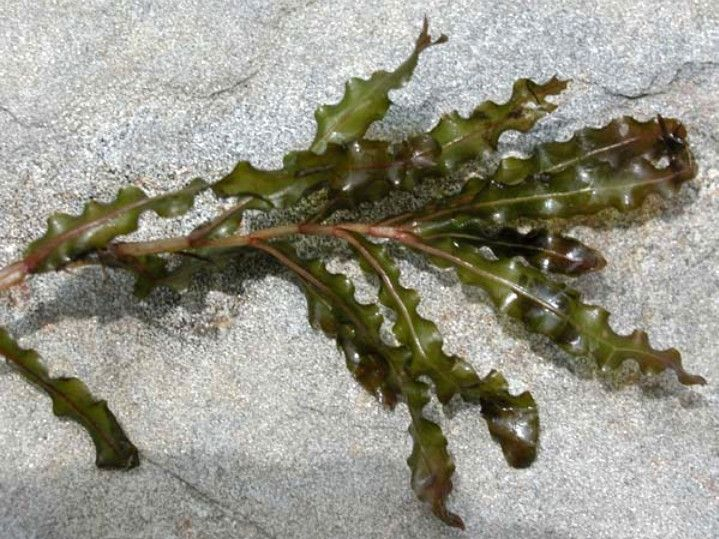
Curly-leaf Pondweed
Curly-leaf Pondweed is an aggressive invasive species. It begins to grow much earlier in the season than other weeds, leading to an uneven resource distribution that chokes out native species.
Curly-leaf Pondweed can be identified through a variety of physical characteristics. It appears reddish-brown in the water, but is actually green when examined out of water. Its leaves are wavy, stiff and crinkled, with a “crispy” texture (0.5 in. wide and 2-3 in. long). The leaves are arranged alternately around the stem and become more dense toward the end of the branches. The leaf tip is blunt and there are small teeth visible along the edge of the leaf (giving the leaf a serrated edge).
Curly-leaf Pondweed has slightly flattened stems and produces winter buds called turions (small, brown pine cones on shortened branches along stem). Flower stalks, when present, stick up above the water surface in June. Curly-leaf Pondweed begins growing in early spring before most pondweeds (leading to a major competitive advantage) and can form dense mats early on in the spring, but by mid summer, it tends to die off a bit.
Curly-leaf Pondweed prefers a habitat where it can grow in depths of up to 15 ft. It also tolerates low water clarity and will readily invade disturbed areas.
Runyan Lake Inc. currently treats curly-leaf pond weed with chemicals as part of our aquatic weed control program to control its growth.
Resources
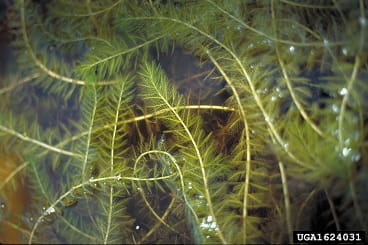
Eurasian Milfoil
Identification:
- Emergent, herbaceous aquatic plant.
- Stems are whitish-pink to reddish-brown.
- Leaves are greyish-green with finely divided pairs of leaflets that are ½-2 inches long, giving the plant a feathery appearance.
- Leaves arranged in whorls of 3-6.
- Yellow or reddish flower with 4 parts on a projected spike sitting 2-4 inches above water.
- Usually 3-10 feet tall with a maximum of 33 feet.
Habitat:
Eurasian watermilfoil inhabits water bodies ranging from fresh to brackish. Areas that have been disturbed are prime habitats for this species. Eurasian watermilfoil is very resistant and can overwinter in frozen lakes and ponds in the northern U.S. or survive over-heated bays in southern states.
Local Concern:
Eurasian watermilfoil forms large mats of floating vegetation that will shade-out native aquatic plants and impede recreational activities. This species is not a valuable food source of waterfowl and may interfere with fish predation. Thick vegetation like this can also clog residential or industrial water intakes.
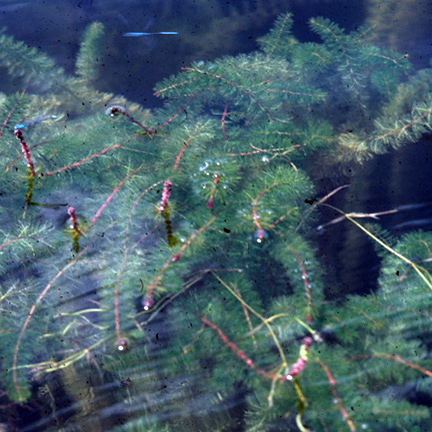
Northern Milfoil
Location:
Grows entirely underwater in depths from 1 to 20 feet.
Description:
Dark-green, feathery leaves are grouped in fours around a hollow stem that is usually buff- or pinkish-colored; leaves are comprised of 5 to 10 pairs of leaflets.
Hints to identify:
Northern watermilfoil is often mistaken for coontail or Eurasian watermilfoil, but it does not branch at the surface as much as Eurasian watermilfoil does; northern typically has half as many leaflet pairs as Eurasian has; northern leaves are rigid when removed from the water, but Eurasian leaves are limp when out of water. The northern species also forms winter buds (groups of small, dark, brittle leaves) in late fall and winter, but the Eurasian variety does not.
Importance of plant:
Provides cover for fish and invertebrates; supports insects and other small animals eaten by fish; waterfowl occasionally eat the fruit and foliage.
Management strategy:
Runyan Lake Inc. currently treats Northern Milfoil with chemicals as part of our aquatic weed control program to manage its growth and thereby allow other native weeds to prosper.
See DNR regulations. When control is absolutely necessary, hand-pulling, raking, or cutting can be effective in small infestations. Collect and dispose of all fragments—-they can regenerate into new plants.
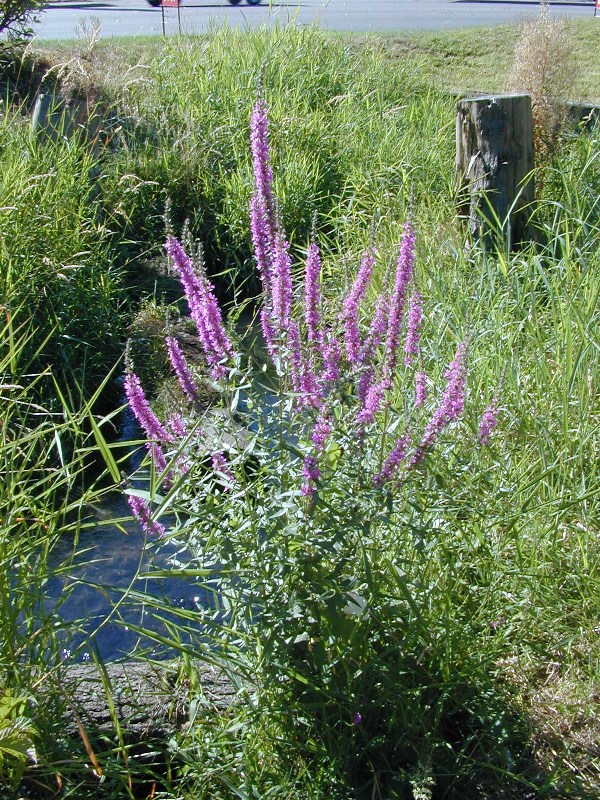
Purple Loosestrife
Purple loosestrife is an invasive perennial plant that is spreading rapidly in North American wetlands, shorelines, and roadside ditches. Thick stands of purple loosestrife crowd out native plants and reduce food, shelter, and nesting sites for wildlife, birds, turtles, and frogs. After multiple introductions in the 1800s for bee keeping, as an ornamental plant, and in discarded soil used as ballast on ships, this European species has invaded nearly every U.S. state and at least six Canadian provinces.
Location:
Purple Loosestrife is a semi-aquatic perennial with showy pinkish-purple flower spikes; vegetation up to eight feet tall, from rootstocks, two to three feet in diameter. From its multiple stems, it produces as many as 2 million seeds from a single mature plant. These seeds, about the size of a grain of sand, blow and/or float to new areas where they absorb water, germinate, and grow. Prolific seed production, and the long life of the root crown, allows Purple Loosestrife to become a very dense monoculture. Purple Loosestrife provides no nutritive value to native insects, animals, or fish.
How It Spreads
Purple loosestrife spreads mainly by seed, but it can also spread vegetatively from root or stem segments. A single stalk can produce from 100,000 to 300,000 seeds per year. Seed survival is up to 60-70%, resulting in an extensive seed bank. Mature plants with up to 50 shoots grow over 6 feet high and produce more than two million seeds each year. Germination is restricted to open, wet soils and requires high temperatures, but seeds remain viable in the soil for many years. Even seeds submerged in water can live for approximately 20 months. Most of the seeds fall near the parent plant, but water, animals, boats, and humans can transport the seeds long distances. Vegetative spread through local perturbation is also characteristic of loosestrife; clipped, trampled, or buried stems of established plants may produce shoots and roots.
What You Can Do
Purple Loosestrife can be treated with herbicides (requires MDEQ permit) or be carefully removed to prevent the seeds from spreading. There are also biological control programs sponsored by Michigan Sea Grant and Michigan State University which provide beetles that consume the flowers of the plant, thus preventing the seeds with cause it to spread.
bullet
- Learn to recognize Purple Loosestrife. We have had quantities in the cove and southwest portion of the lake. Click here for a good article.
- Report any plants found to Runyan Lake Inc. so we can attempt to remove them.
- Inspect and carefully remove the plants, at least the tops with flowers, taking care not to drop flowers or seeds into the lake.
- Removed plants should be placed in a plastic trash bag and put out for removal by your refuse company. with your regular trash
- DO NOT BURN THE PLANTS as this will distribute the seeds.
Runyan Lake Inc. and its members have removed plants from several areas of the lake to control its presence.
Resources
Purple Loosestrife in Michigan
Wisconsin DNR Loosestrife Brochure
Controlling Purple Loosestrife
Starry Stonewort
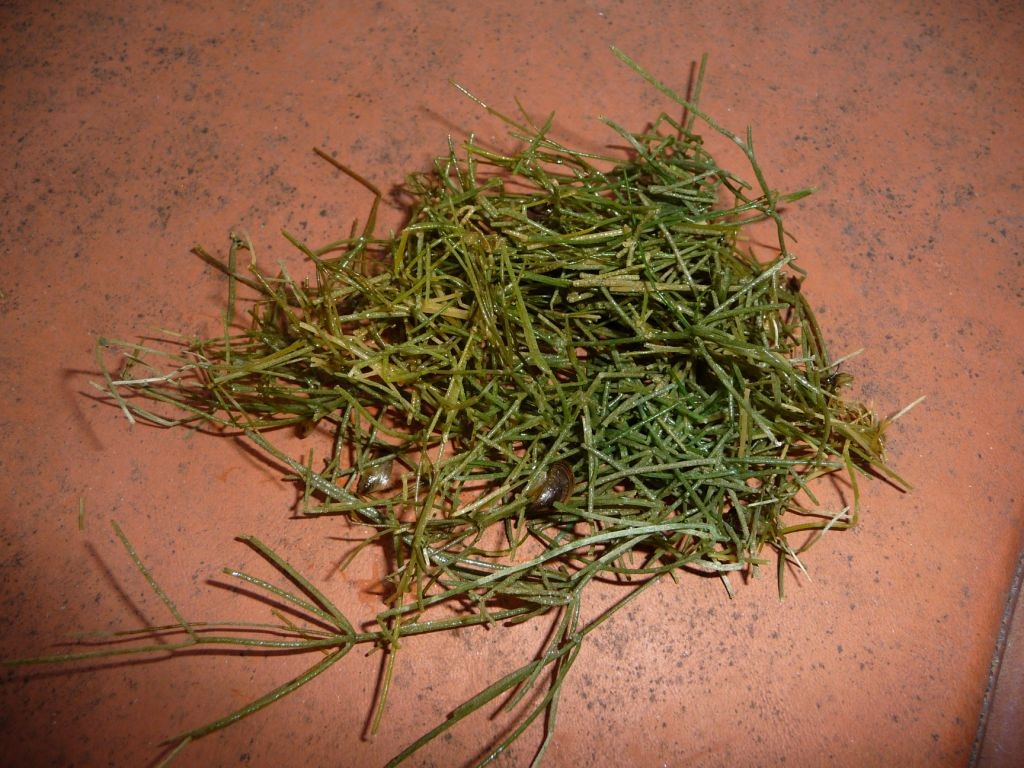
Starry Stonewort was confirmed in Runyan Lake as of 2011. The cove area by the boat ramp, and the shallows immediately outside of the cove saw aggressive growth during the late summer of 2011. It is therefore believed this species entered Runyan Lake by use of the boat ramp. Dense mats of this weed began to impede navigation to the boat ramp during the fall. This should serve as an important reminder to clean your boats and trailers before they enter Runyan Lake to prevent introduction of additional invasive species.
Starry Stonewort resembles the native aquatic plant Chara. Starry Stonewort has tiny, star-shaped, tan-colored reproductive structures called “bulbils” that are firm to the touch when compared to its soft branches. The presence of bulbils is one way to distinguish between Starry Stonewort and Chara. Unlike Chara, which is generally considered to be a beneficial plant, Starry Stonewort has a tendency to colonize deeper water and can form dense mats several feet thick. Starry Stonewort can impede navigation and limit growth of more beneficial plants by choking out native species. The dense mats also reduce or eliminate much of habitat used by bass and bluegill for spawning.
Compared to many other aquatic plants, Starry Stonewort may begin growing later in the season and persist longer, which is exactly what we have experienced near the boat ramp. The really bad news is it is the most aggressive aquatic plant ever observed in Michigan and is able to out compete all other Michigan plant species, including all invasive species and current alien species such as watermilfoil, fanwort, and curly leaf pondweed.
Runyan Lake Inc. will likely begin treatment to minimize the presence of Starry Stonewort with chemicals as part of our aquatic weed control program in 2012.
Resources
A Decade of Starry Stonewort in Michigan: Observations and Operational Management Considerations 1999 to 2009
Douglas Pullman, Ph.D.
Zebra Mussels
Zebra mussels (Dreissena polymorpha) are prolific invaders that cost the U.S. billions of dollars each year. These small mussels from Eurasia can clog water intakes and damage equipment by attaching to boat motors and hard surfaces. They can damage ecosystems by harming fisheries, smothering native mussels and crayfish, and littering beaches with their sharp shells.
In the late 1980s, zebra mussels spread from Europe to the Great Lakes in contaminated ballast water discharged from foreign ships. From there, they expanded to the Mississippi River, its tributaries, and to inland lakes. Zebra mussels spread primarily by attaching to boat hulls, aquatic plants, nets, fishing equipment, or in water. Adult zebra mussels can survive out of water for days under certain conditions.
Your actions are vital to prevent their spread. Please clean your boat and trailer, and any other items which may have been in contact with water from another lake prior to using them in Runyan Lake.
Identify:
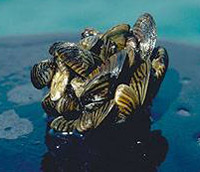
- Zebra mussels look like small clams with a yellowish or brownish “D”-shaped shell, usually with dark and light-colored stripes (hence the name “zebra”).
- They can be up to two inches long, but most are under one inch. Zebra mussels usually grow in clusters containing numerous individuals and are generally found in shallow (6-30 feet), algae-rich water.
- Zebra mussels are the only freshwater mollusk that can firmly attach itself to solid objects – submerged rocks, dock pilings, boat hulls, water intake pipes, etc.
bullet On smooth surfaces, young zebra mussels feel like fine sandpaper. - Juveniles are about the size of peppercorns.
Management
There are currently NO treatment options available, so only the following preventative measures are available to minimize further introduction into our lake.
- Learn to recognize zebra mussels.
- Inspect and remove aquatic plants, animals, and mud from boat, motor, and trailer.
- Drain water from boat, motor, livewell, bilge, and bait containers.
- Dispose of unwanted live bait and worms in the trash. Rinse boat and equipment with high-pressure and/or hot water (104°F), especially if moored for over a day, OR Dry everything for at least 5 days.
- Never introduce fish, plants, crayfish, snails or clams from one body of water to another.
Resources
Invasive Watch — Protect Runyan Lake
Runyan Lake—and many nearby lakes and ponds—faces pressure from aquatic invasive species that harm water quality
and native fish. Explore the guidance below and take simple, effective steps to keep our waters healthy.
Read recommended precautions from the DNR to help prevent disease and invasive species transfer.
Read DNR precautions
What You Can Do — Prevention
- Remove visible mud, plants, fish, or animals from boats, trailers, and fishing gear before transport.
- Wash boats and trailers—use a power washer if available—to dislodge hitchhikers.
- Drain water from boats, motors, trailers, live wells, and any onboard containers before leaving the launch.
- Clean and dry anything that touches the water: boats, trailers, equipment, clothing, and pets.
- Dispose of unwanted fishing bait in the trash—never in the lake.
- Never release plants, fish, or animals unless they came from this body of water.
- Learn to recognize common aquatic invasive species so you can spot and report issues early.
It’s the Law — Civil Infractions
- Do not launch a watercraft or place a trailer in the water if aquatic plants are attached.
- Do not release unused bait into the water.
- Do not transport water over land in bilges or live wells.
Learn more at Michigan Sea Grant — Aquatic Invasive Species.